
Lenovo vs HP: The 2026 Comparison for UK Business Procurement
The USD 6.26 billion UK laptop market might be obsessed with AI-powered silicon in 2026, but for the strategic procurement manager, the real victory in the lenovo vs hp debate isn't found in a processor spec sheet. It's found in the structural integrity of a chassis and the standardisation of the secondary parts market. You've likely seen how a lower upfront cost on a refurbished batch quickly evaporates when failure rates climb or when a simple repair is stalled by a proprietary part shortage. Balancing executive performance demands with strict budget constraints requires more than just a cursory glance at benchmarks.
This analysis provides a definitive professional framework to help you select a refurbished fleet that prioritises long-term reliability and ease of maintenance. We promise to clarify the technical nuances between ThinkPads and EliteBooks whilst addressing the critical issue of component availability in the UK market. We'll examine how chassis design and repairability standards dictate the true lifecycle value of your chosen hardware to ensure your investment delivers a superior return for your organisation.
Key Takeaways
- Contrast magnesium and aluminium chassis to ensure your refurbished hardware survives the rigours of the modern hybrid workplace.
- Compare internal architectures to determine which brand offers the best thermal stability and performance consistency for demanding executive users.
- Master the lenovo vs hp decision by assessing repairability and component availability, ensuring your fleet remains operational with minimal downtime.
- Utilise a strategic framework to select between Lenovo’s anti-glare displays and HP’s BrightView technology based on your organisation's specific ergonomic requirements.
- Maximise your procurement ROI by prioritising hardware designs that allow for efficient RAM and SSD upgrades through accessible bottom-panel entry points.
The UK Enterprise Landscape: Why Lenovo and HP Dominate Professional Computing
Lenovo and HP aren't just manufacturers; they represent the structural backbone of the United Kingdom's corporate infrastructure. For IT directors managing large estates, the lenovo vs hp debate is less about aesthetic preference and more about operational continuity. These two brands have defined the professional-grade standard for decades, creating a duopoly that ensures software stability and driver compatibility across thousands of units. In 2026, as organisations face increased pressure to meet sustainability targets, this dominance has shifted from new-build procurement to the robust secondary market.
The Heritage of Business Computing
The design philosophies of these giants are rooted in distinct historical legacies. Lenovo’s 2005 acquisition of IBM’s PC division didn't just give them a product line; it handed them the ThinkPad, a device engineered for the rigours of space travel and high-stakes finance. This heritage persists in the "function over form" approach that defines their current engineering priorities. HP evolved from a Silicon Valley pioneer into an enterprise hardware powerhouse by focusing on versatile, scalable solutions. Their evolution led to the EliteBook and ProBook series, which balance sleek aesthetics with the durability required by the modern mobile professional.
Market Positioning in the United Kingdom
Standardisation is the primary driver for these brands' success amongst the NHS, education sectors, and FTSE 100 firms. When a hospital trust or a university department deploys hardware, they require a predictable lifecycle. Lenovo and HP provide this through consistent BIOS updates and a vast network of UK-based support. According to data on PC vendor market share, these brands consistently lead the commercial sector, making them the most reliable choice for organisations seeking alternatives to bulk Dell refurbished laptops.
The 2026 UK circular economy has accelerated the adoption of high-quality refurbished fleets. Procurement managers now recognise that a three-year-old EliteBook or ThinkPad often outperforms a brand-new consumer-grade machine. This shift is driven by three key factors:
- Component Availability: The sheer volume of these machines in the UK market ensures a steady supply of original spare parts for repairs and upgrades.
- Build Quality: Professional-grade chassis are designed for a ten-year lifecycle, far exceeding the three-year cycle typical of consumer-grade equipment.
- Driver Management: Enterprise-level support for older hardware simplifies the task of maintaining a secure and updated operating system environment.
Choosing between these brands requires a deep understanding of how their specific engineering choices impact your long-term ROI. Whilst both offer premium reliability, the subtle differences in their construction and maintenance requirements can dictate the success of your procurement strategy.
Engineering and Durability: ThinkPad Magnesium vs EliteBook Aluminium
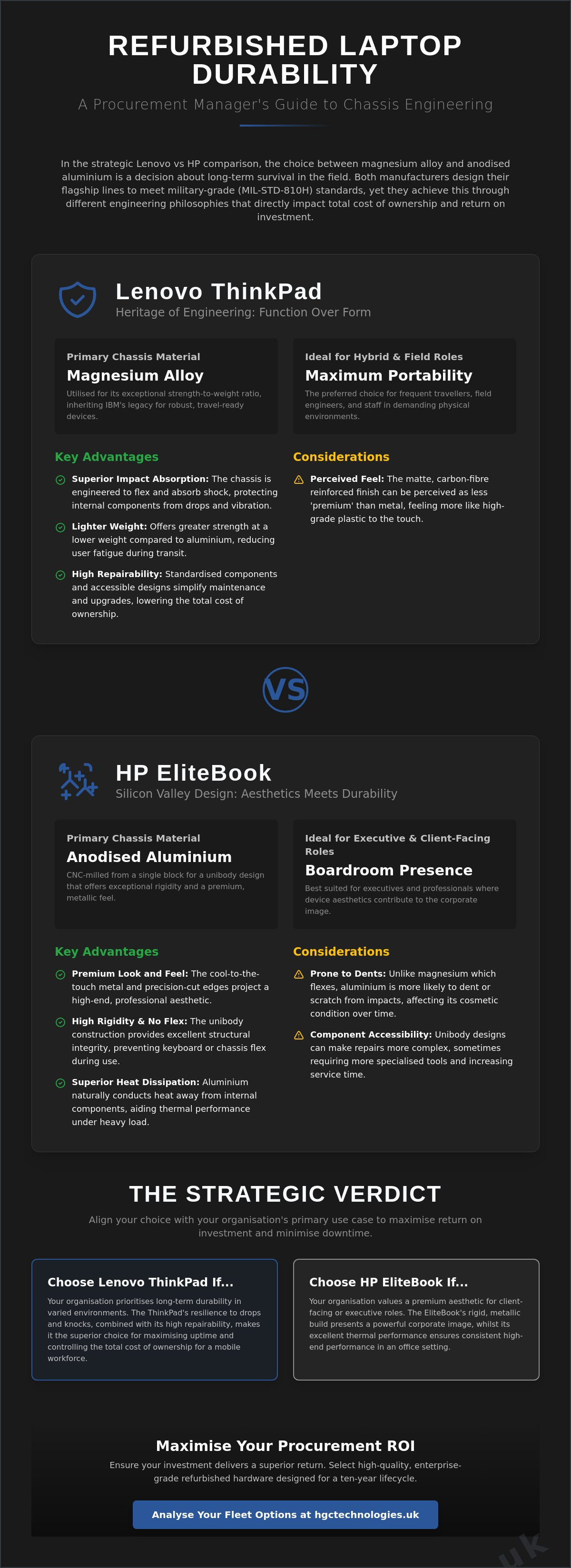
The physical composition of a laptop determines its total cost of ownership more than any internal specification. In the strategic lenovo vs hp comparison, the choice between magnesium alloy and anodised aluminium is a decision about long-term survival in the field. Procurement managers must look beyond the initial sheen. They need to understand how these materials behave under the daily rigours of a UK corporate environment, from the vibration of a train commute to the accidental coffee spill in a busy boardroom.
Both manufacturers design their flagship lines to meet MIL-STD-810H standards. This military-grade certification involves testing against extreme temperatures, humidity, and mechanical shock. However, these brands achieve these standards through different engineering philosophies. Understanding the nuances of long-term durability and repairability is essential for ensuring your fleet doesn't end up in the repair bin within eighteen months of deployment.
Lenovo’s Design Philosophy: Function Over Form
Lenovo ThinkPads are built around a magnesium alloy "roll cage" system. This internal skeleton provides immense structural rigidity whilst allowing the outer shell to remain lightweight. The use of carbon-fibre-reinforced plastics on the lid offers a unique balance; it flexes under pressure rather than cracking or denting. This is why ThinkPads often look "dated" compared to modern consumer ultrabooks. They prioritise impact absorption over aesthetic trends. The legendary spill-resistant keyboard is another mechanical advantage. It features a drainage system that channels liquids away from sensitive internal components, a feature that has saved countless units from terminal damage.
HP’s Aesthetic and Structural Approach
HP EliteBooks take a different path with their CNC-machined aluminium unibody designs. This approach provides a premium, executive feel that rivals high-end consumer hardware whilst maintaining professional-grade stiffness. Aluminium is exceptionally rigid, which protects the internal logic board from flexing. However, it's more prone to visible scuffs and permanent dents than Lenovo’s composite materials. For organisations that prioritise a modern brand image and a "MacBook-like" tactile experience for their staff, the EliteBook is the superior choice. It offers a sleek profile that doesn't sacrifice the durability required for a mobile workforce.
Thermal management also differs significantly between the two. Lenovo tends to use more conservative thermal profiles to ensure the chassis remains cool to the touch. HP often allows for higher peak performance, using the aluminium body as a passive heat sink, though this can result in a warmer underside during intensive tasks. If your procurement strategy requires high-volume, reliable hardware, exploring bulk refurbished professional laptops can significantly lower your capital expenditure without compromising on these engineering standards.
Ultimately, the choice depends on your specific environment. Lenovo’s magnesium and carbon fibre excel in high-impact, data-heavy roles where the keyboard and "bounce-back" durability are paramount. HP’s aluminium mastery offers a more prestigious look and feel for client-facing professionals who still require a machine that can survive a drop from a desk.
Performance and Innovation: A Side-by-Side Technical Comparison
Whilst raw processing power is often identical across professional-grade machines, the way that power is delivered differs significantly. When evaluating lenovo vs hp, the technical winner is usually determined by how well the chassis manages heat and how the manufacturer prioritises secondary components like displays and security chips. For a UK procurement manager, these differences manifest as long-term system stability and user satisfaction. It isn't just about the CPU; it's about how the entire ecosystem supports the worker throughout a standard eight-hour shift.
Component Parity and Brand Divergence
In the 2026 market, both brands utilise the latest Intel Core Ultra and AMD Ryzen AI processors to drive their professional fleets. This means that for standard office tasks, performance is largely brand-agnostic. However, divergence occurs in the proprietary layers. HP’s Wolf Security provides a deeply integrated BIOS protection layer, whilst Lenovo’s ThinkShield focus often results in superior webcam privacy shutters and microphone arrays for hybrid work. Thermal throttling is the intentional reduction of processor speed by the system to prevent damage from overheating during sustained high-performance tasks. Lenovo’s conservative thermal management often leads to more consistent performance over time, whereas HP models might offer higher burst speeds before the cooling systems engage.
The User Experience Factor
Input devices remain a primary differentiator for staff productivity. Lenovo maintains a dedicated following for its TrackPoint nub, whilst HP has focused on expanding the surface area and haptic responsiveness of its glass-topped trackpads. Display technology also presents a clear choice. Lenovo leans heavily into anti-glare finishes to reduce eye strain in brightly lit UK offices. Conversely, HP’s BrightView technology often provides higher peak brightness and better colour accuracy, which is essential for creative or data-visualisation roles. According to PCMag's best work laptops of 2026, these display choices significantly impact the specific use-case suitability of each model.
For those managing refurbished estates, battery health is the critical metric. HP’s Long Life batteries are designed to maintain capacity over a higher number of cycles, which is a significant advantage in the secondary market. Port selection also remains a key procurement consideration. Lenovo has standardised its docking solutions via USB-C and Thunderbolt across the ThinkPad range, simplifying hardware transitions. HP offers similar connectivity but often includes a wider variety of legacy ports on its ProBook series, which can be a deciding factor for firms with older peripheral hardware. These subtle engineering choices ultimately dictate the long-term ROI of your chosen fleet.
Maintenance and Repairability: The Reseller’s Critical Deciding Factor
Repairability isn't just a technical preference; it's the primary engine of profitability for any refurbished laptops reseller supplier. In the high-stakes world of UK IT procurement, the ability to quickly upgrade or fix a unit determines whether a batch meets executive performance demands or becomes a logistical burden. When examining lenovo vs hp from a maintenance perspective, we look at the "time-to-bench" metric. This measures how long it takes a technician to access internal components like the SSD or RAM. The faster the entry, the lower the labour cost per unit.
Lenovo has recently emphasised the increased serviceability of its 2026 ThinkPad T-series, a direct response to the growing demand for sustainable hardware cycles. Most T-series ThinkPads use captive screws that stay attached to the chassis, preventing loss during bulk upgrades. HP has made significant strides with its EliteBook G-series, offering clear internal layouts and labelled components. The secondary parts market in the UK is exceptionally healthy for both brands, but standardisation across generations gives Lenovo a slight edge. A keyboard from a previous generation ThinkPad is often compatible with newer models, simplifying inventory management for large-scale resellers.
The "Right to Repair" in a Corporate Context
Lenovo’s modular philosophy is evident in their 2026 models, which feature replaceable "customer replaceable units" (CRUs). This approach allows for rapid swapping of keyboards and batteries without requiring specialised tools. HP counters this with some of the industry's most comprehensive serviceability manuals. Their EliteBook internals are designed for transparency, making it easy for technicians to identify and replace faulty modules. This ease of repair directly impacts the final grading of refurbished units; machines that are easier to service are more likely to reach Grade A status, which is a vital factor in the lenovo vs hp value proposition.
Lifecycle Management for Resellers
Component cannibalisation is a vital strategy for maintaining older fleets. When a unit suffers terminal motherboard failure, its screen, keyboard, and chassis remain valuable assets for future repairs. Lenovo’s hardware is often easier to "strip and fix" due to the lack of proprietary adhesives in key areas. Firmware and driver longevity also play a role; both brands offer long-term support, ensuring that 2026 fleets remain secure for years. To maximise your ROI, ensure you partner with a provider that delivers consistent bulk Lenovo refurbished laptops quality to avoid inconsistent component batches.
If you're looking to secure a reliable, repairable fleet for your clients, browse our current wholesale laptop inventory to find the best fit for your procurement needs.
The Verdict: Choosing the Right Brand for Your Procurement Strategy
The definitive winner in the lenovo vs hp debate depends entirely on the operational environment you intend to support. There is no universal "superior" brand; instead, there is a superior fit for specific professional workflows. For UK procurement managers, the goal is to align hardware engineering with user behaviour whilst maintaining a sustainable lifecycle that supports the organisation's ESG targets. Choosing a refurbished fleet from either manufacturer is a significant step towards participating in the circular economy, reducing e-waste without compromising on enterprise-grade performance.
Scenario-Based Recommendations
Staff requirements should dictate your hardware selection. We recommend the following alignments based on common corporate roles:
- High-Mobility Sales and Executive Teams: The HP EliteBook series is the standout choice. Its aluminium unibody design provides a premium aesthetic for client-facing roles, and the BrightView display technology ensures high visibility in varied lighting conditions during travel.
- Engineering, Coding, and Data Analysis: The Lenovo ThinkPad T-Series remains the industry standard. The combination of magnesium alloy rigidity, the tactile precision of the keyboard, and conservative thermal management makes it ideal for sustained, high-intensity technical workloads.
- Budget-Conscious Educational or Admin Deployments: The Lenovo L-Series or HP ProBook offer the best ROI. These models provide the core security and durability features of their flagship siblings but at a lower price point, making them perfect for large-scale rollouts in schools or back-office environments.
Strategic Sourcing with HGC Technologies UK Ltd.
Securing the right fleet is only half the battle; the other half is ensuring the quality of your supply chain. HGC Technologies UK Ltd. de-risks the procurement process by acting as a knowledgeable guide through the complexities of wholesale hardware. We specialise in providing Bulk Lenovo Refurbished Laptops and Bulk HP Refurbished Laptops that have undergone a rigorous multi-point testing and grading process. This ensures that every unit in your batch meets a consistent standard of excellence before it reaches your site.
Our expertise extends beyond mobile computing. We provide Custom-built PCs and Server Solutions to help you build a cohesive IT infrastructure. By choosing a direct wholesale model with national UK delivery, your organisation maximises its ROI and gains a partner dedicated to long-term reliability. Whether you are an IT reseller looking for consistent stock or a procurement manager balancing executive demands with budget constraints, our commitment to quality ensures your chosen fleet performs from day one. Confidence in your hardware allows you to focus on growth rather than maintenance, ensuring your organisation remains agile in the competitive 2026 landscape.
Future-Proofing Your UK IT Infrastructure
Mastering the lenovo vs hp decision requires a strategic look at how hardware engineering meets the practical needs of your workforce. Whether you prioritise the magnesium-reinforced resilience of a ThinkPad or the premium aluminium finish of an EliteBook, the key to a successful deployment lies in selecting hardware that supports a long-term, repairable lifecycle. By focusing on component availability and structural integrity, you ensure your organisation benefits from a sustainable fleet that meets both executive performance demands and strict budget constraints.
HGC Technologies UK Ltd. acts as your specialist UK-wide wholesale distributor and trusted partner. Our expert-led refurbishment and grading process ensures that every unit in our inventory meets the exacting standards required by modern IT resellers and corporate procurement managers. We're dedicated to de-risking your procurement through consistent quality and localised expertise.
Take the next step in optimising your hardware estate. Explore our current wholesale inventory of Lenovo and HP laptops to secure the superior fleet your organisation deserves. We look forward to supporting your long-term technological growth.
Frequently Asked Questions
Is Lenovo better than HP for long-term business use?
The choice between lenovo vs hp for long-term use depends on your specific environment rather than a universal winner. Lenovo often provides a slight advantage in structural resilience for high-impact roles due to their internal magnesium roll cages. Conversely, HP excels in aesthetic longevity; their aluminium designs maintain a premium appearance in client-facing scenarios. Both brands offer robust enterprise support and consistent BIOS updates, ensuring a stable lifecycle for your organisation.
Which brand, Lenovo or HP, is easier to repair when bought refurbished?
Lenovo ThinkPads are generally easier to repair for refurbished fleets due to their modular "Customer Replaceable Units" and captive screw designs. This engineering choice allows technicians to swap keyboards or batteries in minutes without specialised tools. Whilst HP EliteBooks are also highly serviceable and come with excellent technical manuals, they sometimes require more internal disassembly to reach certain modules. For resellers, the ThinkPad’s accessibility often translates to lower labour costs per unit.
Are refurbished ThinkPads more durable than refurbished EliteBooks?
ThinkPads tend to handle mechanical shock better because their magnesium and carbon-fibre chassis flex under impact rather than cracking. This makes them exceptionally durable for mobile workers who frequent construction sites or travel heavily. Refurbished EliteBooks are equally rigid but their aluminium shells are more prone to visible scuffs and permanent dents. If cosmetic perfection is your priority, HP is the winner; if survival against drops is paramount, Lenovo is the superior choice.
What is the best HP laptop series for corporate procurement in the UK?
The HP EliteBook 800 series is widely considered the gold standard for UK corporate procurement. These machines offer a refined balance of security through HP Wolf Security, high-performance processors, and a versatile selection of ports. They are designed to integrate seamlessly into modern office environments, providing the reliability required for executive roles whilst remaining portable enough for hybrid work. The ProBook series serves as a robust, cost-effective alternative for general administrative staff.
Does Lenovo or HP have better battery life in ex-corporate models?
HP typically offers better battery longevity in ex-corporate models thanks to their Long Life battery chemistry, which is designed to endure more charge cycles. This technology helps maintain capacity even after several years of professional use. Lenovo models are also competitive, but their battery health often depends more on the specific power management settings used by the previous owner. Always check the battery health report from your supplier to ensure the unit meets your requirements.
How do I choose between Lenovo and HP for a large school deployment?
For large school deployments, the decision between lenovo vs hp should focus on the specific user group. Lenovo L-series models are often preferred for students because their spill-resistant keyboards and reinforced hinges survive heavy-handed use. HP ProBooks are excellent for teaching staff who require a wider variety of legacy ports to connect to older classroom projectors or peripherals. Standardising on one brand across the school simplifies IT support and reduces the variety of spare parts needed.
Why is there a price difference between refurbished Lenovo and HP units?
Price variations in the refurbished market are driven by original RRP and current UK stock levels rather than a simple brand hierarchy. High-volume corporate retirements of a specific HP model can lead to lower prices due to market saturation. Conversely, a rarer high-specification ThinkPad will command a premium. The price also reflects the grading; a Grade A Lenovo unit will naturally cost more than a Grade B HP unit, regardless of the internal specifications.
Can I mix Lenovo and HP laptops within the same corporate fleet?
Whilst you can mix Lenovo and HP laptops within a single fleet, it isn't recommended for larger organisations due to the increased complexity of IT management. Managing two different sets of drivers, BIOS updates, and proprietary security software can strain your technical team. Additionally, whilst USB-C docking stations are largely universal, brand-specific features like remote power-on buttons often only work within a single-brand ecosystem. Maintaining a unified fleet ensures a more consistent user experience.