
Environmental Impact of Buying New vs Refurbished Tech: A 2026 UK Business Guide
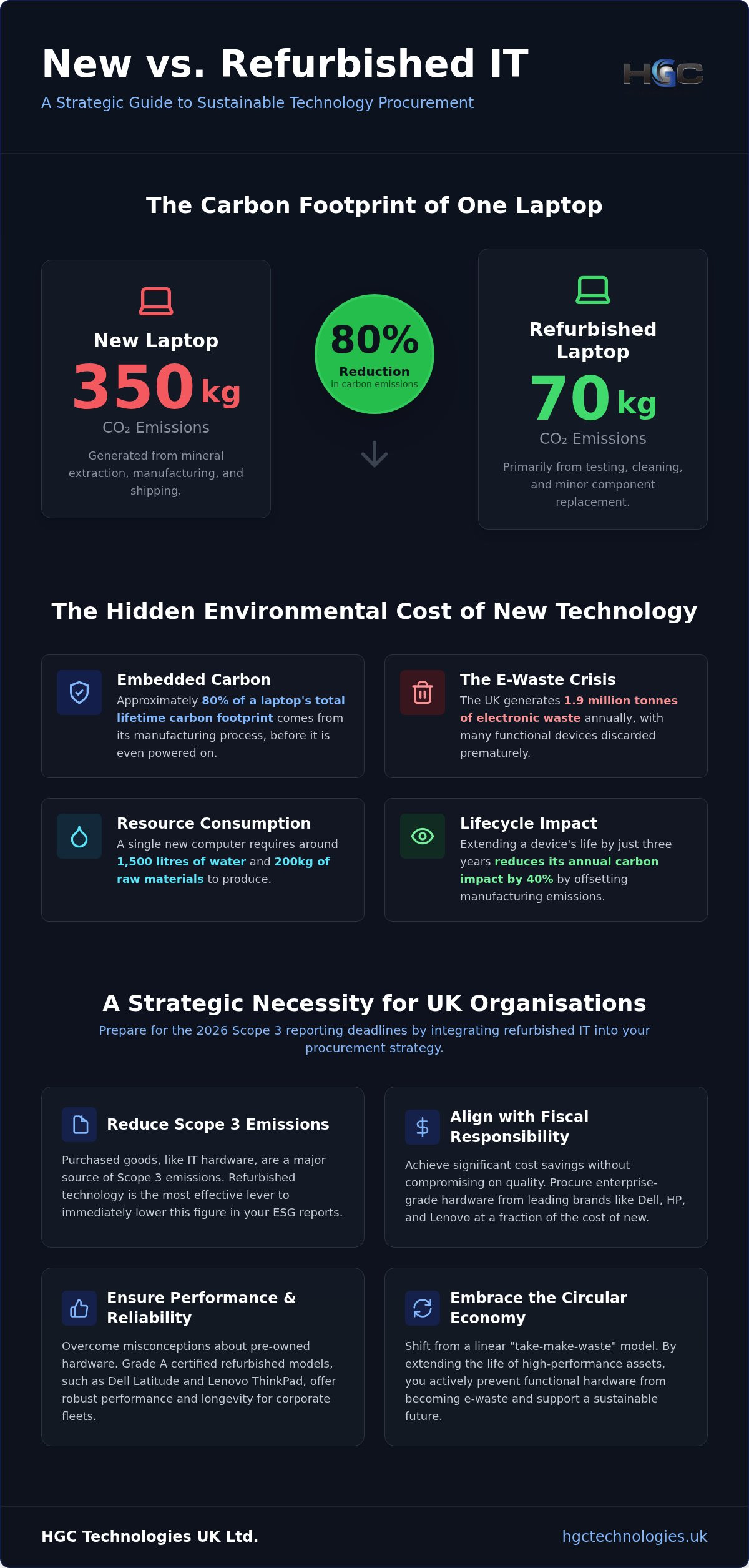
Manufacturing a single new laptop generates approximately 350kg of carbon emissions, whilst a certified refurbished alternative requires just 70kg. For UK organisations facing the 2026 Scope 3 reporting deadlines, this 80% reduction represents the most immediate lever for lowering a corporate carbon footprint. Understanding the environmental impact of buying new vs refurbished tech is no longer just a CSR preference; it's a strategic necessity for any business aiming to meet net-zero targets without compromising on hardware performance.
You're likely feeling the pressure to deliver robust ESG reports whilst navigating the reality of limited procurement budgets. It's a difficult balance to strike, especially when misconceptions about the reliability of pre-owned hardware persist. This guide provides the definitive data you need to present a clear case to stakeholders. We will outline a practical framework for sustainable IT procurement and demonstrate how enterprise-grade hardware from brands like Dell, HP, and Lenovo can be successfully integrated into a high-performance circular economy. This approach ensures that your technological expansion aligns with both fiscal responsibility and environmental stewardship.
Key Takeaways
- Gain a clear understanding of embedded carbon and learn how extending hardware lifecycles significantly reduces the volume of electronic waste generated by UK organisations.
- Access definitive data to quantify the environmental impact of buying new vs refurbished tech, allowing you to present a compelling case for sustainability to your stakeholders.
- Prepare for the 2026 ESG reporting deadlines by discovering why refurbished hardware is the most effective tool for reducing your company’s Scope 3 emissions.
- Establish a reliable procurement framework using high-performance, enterprise-grade models such as Dell Latitude and Lenovo ThinkPad to ensure fleet longevity and user satisfaction.
- Learn how to source bulk hardware through direct-from-corporate models that guarantee Grade A quality whilst supporting your net-zero transition.
The Hidden Environmental Cost of New Technology
Every new piece of hardware carries a heavy ecological burden known as embedded carbon. This term describes the total greenhouse gas emissions generated during a device's entire creation process, from initial mineral extraction to final assembly and transport. Research indicates that the manufacturing phase accounts for approximately 80% of a laptop's total lifetime carbon footprint. This means that before a device is even switched on for the first time, it has already caused significant damage. Understanding the environmental impact of buying new vs refurbished tech starts with acknowledging that the cleanest energy is the energy we never spend on new production.
The Global E-Waste Crisis and the UK Market
UK corporations discard thousands of tonnes of functional hardware annually, contributing to a growing national crisis. The Hidden Environmental Cost of New Technology is evident in the fact that the UK remains one of the world's largest per-capita producers of electronic waste. Most businesses still operate on a linear "take-make-waste" model, where perfectly capable machines are binned once a lease ends. Adopting the solutions wholesale refurbished computers UK providers offer is the primary way to disrupt this cycle. By shifting to a circular economy, organisations keep high-performance assets in use, preventing them from becoming part of the 1.9 million tonnes of e-waste the UK generates each year.
Raw Material Extraction and Biodiversity Loss
Extracting the rare earth minerals required for high-performance PC components, such as cobalt and lithium, causes irreversible biodiversity loss. Mining these materials is an energy-intensive process that often destroys local ecosystems and pollutes fresh water sources. It takes roughly 1,500 litres of water and 200kg of raw materials to produce a single computer. Extending a device's operational life by just three years reduces its annual carbon impact by 40%. Urban Mining is the strategic process of reclaiming these precious materials from existing technology rather than digging new holes in the ground. Choosing to refurbish enterprise-grade hardware isn't just a budget decision; it's a direct intervention against environmental degradation.
Life Cycle Assessment: New vs Refurbished Carbon Footprints
Life Cycle Assessment (LCA) serves as the definitive methodology for quantifying ecological damage in the technology sector. By evaluating every stage of a product's life, from raw material extraction to end-of-life disposal, LCA reveals the stark reality of the environmental impact of buying new vs refurbished tech. Whilst manufacturing is a high-heat, energy-intensive ordeal, professional refurbishment is a restorative process that preserves the initial energy investment. This distinction is vital when calculating the Carbon Payback Period. This metric determines how long a device must be used before its operational efficiency offsets its manufacturing emissions. For most enterprise laptops, this period exceeds their initial three-year corporate lease, meaning they are often retired whilst still in "carbon debt."
The Life Cycle Assessment: New vs Refurbished Carbon Footprints approach highlights that professional refurbishment ensures Grade A performance whilst keeping high-quality components in circulation. If your organisation is looking to improve its sustainability profile, exploring high-quality refurbished hardware is a proven first step toward balancing performance with ecological responsibility.
Comparing Carbon Emissions: Laptops and Servers
The data gap between new production and refurbishment is significant. Producing a new business laptop typically emits over 300kg of CO2e, whereas the emissions associated with the refurbishment process itself are often as low as 25-30kg. This represents a 90% reduction in immediate carbon output. The stakes are even higher for enterprise server hardware UK procurement. Servers contain a higher density of rare metals and complex circuit boards, resulting in a massive embedded carbon cost that can only be justified through extended use. Choosing refurbished servers allows data centres to scale capacity without the massive carbon spike associated with new silicon fabrication.
Water Usage and Chemical Pollution
Carbon is only one part of the story; the manufacturing of a single computer requires approximately 1,500 litres of fresh water. Much of this is used in semi-conductor fabrication, a process that also generates toxic chemical runoff. Refurbishment avoids these secondary pollutants entirely. By opting for Grade A refurbished units, businesses prevent the need for new microchip production, effectively "saving" thousands of litres of water per fleet refresh.
- Manufacturing a new laptop: ~350kg CO2e and 1,500 litres of water.
- Refurbishing an existing laptop: ~70kg CO2e and minimal water consumption.
- Refurbishment prevents toxic runoff from semi-conductor plants.
Scope 3 Emissions: Why Refurbished Tech is Vital for UK Business ESG
Scope 3 emissions represent the most significant challenge for UK procurement officers aiming for net-zero targets. These are indirect emissions occurring throughout a company's value chain, including the carbon footprint of purchased goods like IT hardware. Under the EU Corporate Sustainability Reporting Directive (CSRD) and evolving UK standards, the first Scope 3 reports are due in 2026. This mandate forces approximately 50,000 companies to account for the carbon embedded in their supply chains. Integrating refurbished hardware is the most efficient way to decarbonise an IT estate. It removes the massive manufacturing emissions discussed in previous sections from the corporate ledger. Research from the Scope 3 Emissions: Why Refurbished Tech is Vital for UK Business ESG report by United Nations University highlights how global e-waste flows can be mitigated through such strategic reuse.
Transitioning to a circular model is no longer optional for businesses seeking long-term stability. By choosing to reuse, organisations directly lower the environmental impact of buying new vs refurbished tech within their own operations. This shift supports the broader UK goal of reducing electronic waste whilst meeting stringent ESG criteria. It also addresses the "social" aspect of ESG by supporting UK-based circular economy businesses that prioritise local expertise and ethical labour practices.
Meeting Net-Zero Targets in Corporate Procurement
Procuring bulk Dell refurbished laptops provides immediate, quantifiable carbon savings for annual reports. Instead of reporting 350kg of CO2e per new device, businesses record a fraction of that figure for refurbished units. Understanding the environmental impact of buying new vs refurbished tech allows procurement teams to make data-driven decisions that satisfy both the CFO and the sustainability officer. Tenders are shifting rapidly. Government and enterprise contracts now frequently prioritise the "lowest carbon" option over the "lowest price" alone. To pass sustainability audits, organisations must document these purchases with certificates that verify the carbon avoided. This data becomes a strategic asset during stakeholder presentations and ESG disclosures.
The Circular Economy and Corporate Responsibility
Adopting a refurbished-first policy allows UK businesses to lead the transition toward a circular economy. The Circular Economy is a system aimed at eliminating waste through the continual use of resources. This approach moves beyond the traditional ownership model toward lifecycle extension and "Product as a Service" concepts. By supporting UK-based circular businesses, organisations bolster local expertise and sustainable jobs whilst demonstrating a commitment to ethical procurement. Leading by example in this way encourages suppliers and partners to adopt similar standards, creating a ripple effect of responsibility across the entire value chain. It’s a powerful way to demonstrate that corporate growth doesn’t have to come at the expense of the planet.
Developing a Sustainable IT Procurement Strategy for Organisations
Successful IT procurement requires more than just reactive buying; it demands a structured approach to hardware lifecycles. Standardising your fleet with enterprise-grade models like the Dell Latitude or Lenovo ThinkPad simplifies internal maintenance and ensures long-term software compatibility across the organisation. By focusing on these high-tier machines, businesses can significantly mitigate the environmental impact of buying new vs refurbished tech whilst maintaining peak operational standards. Enterprise hardware is designed for a decade of use, making it the ideal candidate for a second or third life in a corporate environment.
Grade A refurbishment isn't merely about aesthetics. It's a technical guarantee of structural integrity and component longevity. Partnering with a dedicated wholesale laptop distributor UK partner ensures you receive consistent hardware batches, which is essential for seamless image deployment and helpdesk efficiency. Professional refurbishers employ rigorous multi-point testing protocols that often exceed the quality control found in consumer-grade factories, effectively dismantling the myth that pre-owned means unreliable.
Bulk Sourcing for Schools, NGOs, and SMEs
Schools and NGOs often face the most difficult choice between restrictive budgets and ambitious green mandates. Sourcing bulk Lenovo refurbished laptops allows these sectors to deploy robust, high-performance machines at a fraction of the ecological cost. When planning a large-scale rollout, use the following checklist to ensure consistency:
- Verify the refurbishment grade is "Grade A" to ensure user satisfaction.
- Confirm Windows 11 compatibility to meet 2026 security standards.
- Request identical specifications across the batch for easier IT management.
- Audit the vendor's ability to provide data for your sustainability reports.
Hardware Lifespan and Future-Proofing
A three-year-old high-spec workstation will almost always outperform a brand-new budget laptop. Enterprise machines are built with premium materials like magnesium alloy chassis and spill-resistant keyboards, features rarely found in entry-level new tech. Custom PC builds and bespoke server configurations can further extend the life of your existing infrastructure, delaying the need for carbon-intensive replacements. Regular internal cleaning and battery health monitoring ensure these machines remain reliable for five years or more. If you're ready to transition your organisation to a more sustainable model, view our range of enterprise-grade refurbished hardware to start your procurement journey today.
Sourcing Reliable Bulk Refurbished Hardware from HGC Technologies
HGC Technologies UK Ltd. operates at the intersection of high-performance IT and ecological responsibility. As a specialist wholesaler, we focus on extending the lifecycle of enterprise-grade hardware to provide UK businesses with a viable alternative to the traditional linear procurement model. Our direct-from-corporate sourcing model ensures that we maintain absolute quality control whilst preventing functional technology from entering the waste stream prematurely. By choosing a partner that manages the entire refurbishment lifecycle, organisations can accurately quantify the environmental impact of buying new vs refurbished tech for their ESG disclosures.
Procurement at scale offers logistical advantages that extend beyond simple cost savings. Bulk purchasing significantly reduces transport-related carbon emissions by consolidating shipments and reducing the frequency of individual deliveries. This efficient approach to logistics is a vital component of a modern, sustainable procurement strategy that seeks to minimize a company's overall carbon footprint. Beyond our core laptop offerings, we provide a comprehensive range of original smartphones wholesale UK for corporate fleets, ensuring that your mobile strategy is as green as your desktop infrastructure.
Quality Assurance and Professional Refurbishment
Our refurbishment process is methodical, steady, and thorough. Every device undergoes a rigorous multi-point testing regime that covers everything from motherboard component checks to final OS installation and stress testing. We focus exclusively on Dell, HP, and Lenovo hardware because these manufacturers prioritise durability and modular repairability in their enterprise lines. This superior engineering allows us to restore machines to a standard that rivals new equipment in both performance and appearance. For organisations with specific technical needs, we offer bespoke consultations for custom PC builds and server configurations tailored to high-demand corporate environments.
Your Partner in Sustainable UK Tech
HGC Technologies acts as your dedicated partner in achieving UK net-zero targets through smart procurement. We simplify the complexities of wholesale sourcing, providing the clear data and reliable hardware needed to meet 2026 sustainability standards with confidence. Operating as a national wholesaler based in the UK, we offer logistical stability and reduced lead times without the massive environmental cost of international air freight. Our commitment to excellence ensures that your transition to a circular economy is both seamless and strategically advantageous. Contact our team today for bulk enquiries and current inventory lists to begin the process of de-carbonising your IT estate whilst maintaining unmatched operational standards.
Future-Proofing Your IT Procurement for a Circular Economy
The transition toward a circular economy is no longer a peripheral concern but a core strategic requirement for UK organisations. By prioritising the reuse of enterprise-grade hardware, businesses can drastically reduce their embedded carbon and meet the 2026 Scope 3 reporting requirements with precision. Understanding the environmental impact of buying new vs refurbished tech is the first step toward a more responsible corporate strategy that balances high-performance requirements with net-zero obligations. It's a shift that moves your organisation from a traditional linear model to one that values longevity and resource preservation.
As a national wholesale specialist for Dell, HP, and Lenovo, HGC Technologies provides the reliable infrastructure needed for this transition. We provide national UK coverage for corporate and educational sectors, delivering Grade A refurbished hardware at direct wholesale pricing. Standardising your fleet with these robust machines doesn't just protect your budget; it actively safeguards the environment for future generations. View our latest bulk inventory of refurbished business laptops and begin your journey toward a more sustainable and efficient technological future today.
Frequently Asked Questions
Is refurbished tech really as good for the environment as people claim?
Yes, refurbished technology is a cornerstone of sustainable IT because it prevents functional hardware from becoming e-waste. By extending the life of a device, you bypass the resource extraction and manufacturing phases that generate the majority of a machine's carbon footprint. This choice directly reduces the environmental impact of buying new vs refurbished tech by keeping high-quality components in circulation and reducing the immediate demand for new, carbon-intensive silicon production.
How much carbon dioxide is saved by buying a refurbished laptop vs a new one?
Opting for a refurbished laptop saves approximately 280kg of CO2e per device. A new enterprise laptop typically carries an embedded carbon cost of 350kg, whereas a professionally refurbished equivalent accounts for roughly 70kg. For a department refreshing 100 machines, this equates to a 28-tonne reduction in carbon emissions. These quantifiable figures are essential for organisations documenting their progress toward net-zero targets and fulfilling modern corporate social responsibility obligations.
What are Scope 3 emissions and why do they matter for my UK business?
Scope 3 emissions are indirect greenhouse gas emissions that occur in your company’s value chain, including the production of purchased goods. For UK businesses, reporting these is becoming a legal necessity under the 2026 sustainability disclosure standards. Since IT hardware often represents a significant portion of these indirect emissions, choosing refurbished equipment is a primary strategy for de-carbonising your supply chain and ensuring compliance with evolving national reporting requirements.
Does refurbished technology have a shorter lifespan than new hardware?
No, enterprise-grade refurbished hardware often outlasts new consumer-level laptops. Models like the Dell Latitude or Lenovo ThinkPad are engineered for a decade of service, whereas budget-tier new devices often use lower-quality materials. When you choose Grade A refurbished hardware, you are receiving a machine that has been rigorously tested and restored. This ensures the device can reliably serve your organisation for five years or more with proper maintenance and standard software updates.
Can I source enough refurbished laptops in bulk for an entire department?
Yes, specialist wholesalers like HGC Technologies provide bulk quantities of identical models to ensure fleet consistency. We maintain large inventories of Grade A Dell, HP, and Lenovo machines, allowing procurement managers to standardise their departments with uniform specifications. This consistency is vital for seamless OS deployment and internal IT support. Sourcing in bulk also reduces the logistical carbon footprint, further improving the overall environmental impact of buying new vs refurbished tech.
What is the difference between "used" and "professionally refurbished" tech?
"Used" technology is typically sold "as is" without testing or guarantees, whilst "professionally refurbished" hardware undergoes a strict restorative process. This includes internal cleaning, multi-point component testing, and data sanitisation. Professionally refurbished devices are also graded for quality, with Grade A representing the highest standard. This ensures that the hardware meets specific performance benchmarks and aesthetic requirements, providing a level of reliability and security that simple used equipment cannot offer.
How does the circular economy apply to corporate IT procurement?
The circular economy replaces the traditional "take-make-waste" model with a system focused on the continual use of resources. In corporate procurement, this means prioritising the reuse and refurbishment of hardware rather than buying new and discarding after a single lease. By keeping enterprise-grade laptops in circulation for a second or third lifecycle, businesses reduce the demand for raw material extraction and significantly lower the volume of electronic waste sent to UK landfills.
Are there specific UK regulations regarding e-waste and business tech?
UK businesses must comply with the Waste Electrical and Electronic Equipment (WEEE) regulations, which mandate the responsible disposal of tech assets. Additionally, the 2026 reporting deadlines for sustainability mean that larger organisations must now account for the carbon footprint of their hardware procurement. These regulations are designed to encourage a shift toward more sustainable practices, making the adoption of refurbished hardware a key component of legal and environmental compliance for modern UK enterprises.