
Cost-Effective IT Procurement UK: A 2026 Strategic How-To Guide
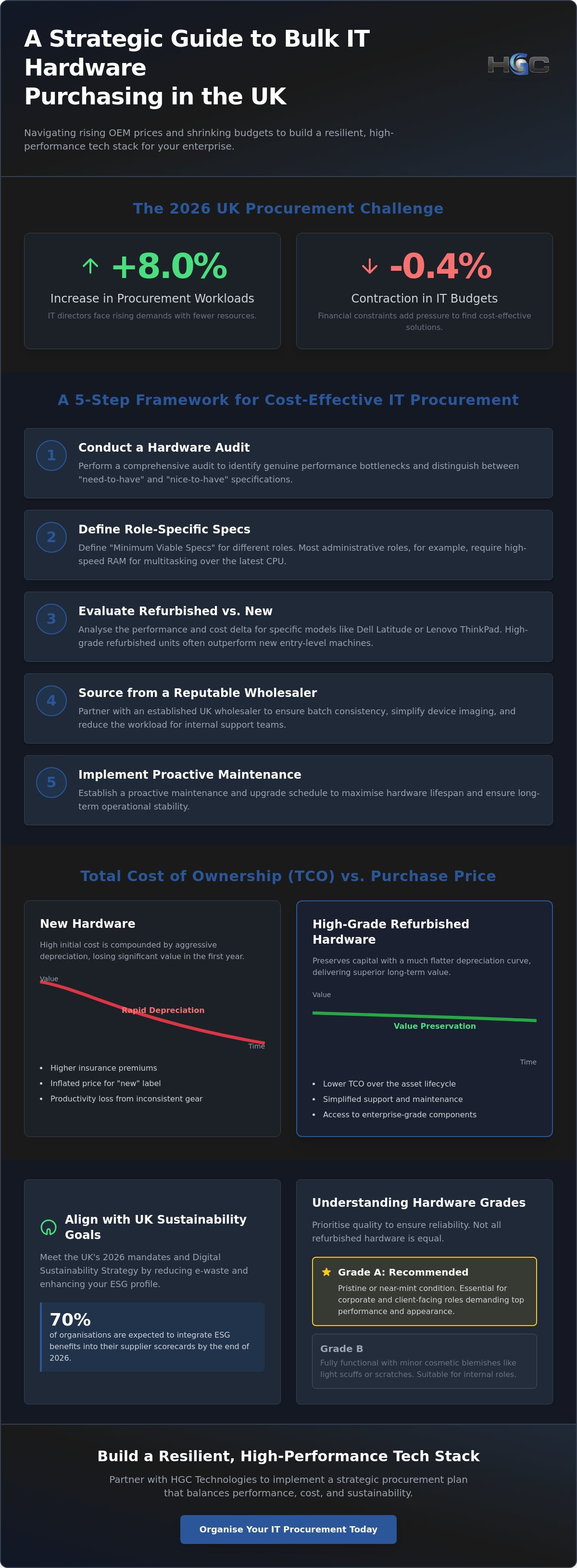
While UK procurement workloads are set to increase by 8.0% this year, budgets are simultaneously contracting by 0.4%, leaving IT directors in a difficult position. You're likely facing the dual pressure of rising OEM prices and the need to maintain consistent hardware standards for remote teams. This bulk hardware purchasing guide UK provides the strategic framework needed to bridge this productivity gap without sacrificing the enterprise-level performance your operations demand.
It's a common concern that moving away from brand-new equipment might compromise reliability, but the procurement landscape has shifted significantly. We'll show you how to master the art of reducing IT spend through high-grade refurbished sourcing and bespoke hardware configurations that don't fail under pressure. You'll learn how to implement a robust lifecycle management plan, verify quality standards for Dell, Lenovo, and HP units, and ultimately reduce your total cost of ownership whilst meeting the UK's 2026 sustainability mandates. This guide moves beyond simple cost-cutting to help you build a resilient, high-performance tech stack that's ready for the future.
Key Takeaways
- Redefine cost-effectiveness by balancing high-level performance and hardware longevity against acquisition costs to combat rising 2026 logistics expenses.
- Establish a clear five-step procurement framework that begins with a comprehensive hardware audit and the definition of role-specific performance requirements.
- Master the nuances of the wholesale grading system to ensure your organisation prioritises Grade A hardware for essential corporate and client-facing roles.
- Utilise this bulk hardware purchasing guide UK to implement batch procurement strategies that simplify device imaging and reduce the workload for internal support teams.
- Align your procurement with 2026 sustainability goals by sourcing high-volume, refurbished Dell, Lenovo, or HP laptops from established industry leaders.
What is Cost-Effective IT Procurement in the 2026 UK Market?
True cost-effectiveness isn't merely about finding the lowest sticker price. In the 2026 market, it's a strategic calculation that balances hardware performance, long-term durability, and the initial acquisition cost. Many UK enterprises are moving away from traditional OEM lease cycles because the financial burden of new silicon and rising logistics costs has become unsustainable. By adopting a "Spec-First" sourcing model, businesses focus on the internal capabilities needed for specific roles rather than paying a premium for the "new" label. This bulk hardware purchasing guide UK highlights how high-grade refurbished units often outperform entry-level new machines at a fraction of the cost.
The shift towards circular economy IT is no longer a niche choice; it's a commercial necessity. As of April 2026, the UK's Procurement Act 2023 has formalised stricter standards for transparency and value, pushing decision-makers to look beyond the surface. Sophisticated e-procurement processes now allow decision-makers to look beyond basic inventory management and evaluate the entire lifecycle of their assets. Choosing refurbished hardware allows you to secure enterprise-grade Dell, Lenovo, or HP machines that were built for 24/7 corporate environments, ensuring your team has the power they need without the inflated price tag of a brand-new unit.
The Role of Sustainable IT Hardware
Prioritise longevity through sustainable IT hardware UK to align with the government's Digital Sustainability Strategy 2025–2030. This shift reduces e-waste and offers significant ESG benefits, which 70% of organisations are expected to integrate into their supplier scorecards by the end of 2026. Business-grade components found in refurbished laptops are engineered for heavy professional use, offering far superior durability compared to consumer-grade gear found in retail outlets. By choosing high-grade refurbished units, you're not just saving money; you're investing in a more responsible and resilient infrastructure.
Total Cost of Ownership (TCO) vs. Purchase Price
New hardware suffers from aggressive depreciation, often losing a massive portion of its value in the first twelve months. Refurbished units follow a much flatter depreciation curve, preserving your capital for longer. You must also consider hidden costs like higher insurance premiums for new equipment and the productivity loss associated with inconsistent hardware across remote teams. Selecting a uniform batch of high-grade refurbished laptops simplifies your support requirements and lowers maintenance costs. In 2026, TCO represents the sum of all expenses associated with a hardware asset throughout its entire lifecycle, from procurement and deployment to maintenance and eventual decommissioning.
How to Organise Your IT Procurement Strategy: A 5-Step Guide
Efficient procurement requires a methodical approach that moves away from reactive buying. To truly master your budget, you need a repeatable framework that ensures every pound spent contributes to operational stability. This bulk hardware purchasing guide UK outlines the five essential stages for a modern, cost-effective strategy.
- Step 1: Conduct a comprehensive hardware audit to identify genuine performance bottlenecks.
- Step 2: Define "Minimum Viable Specs" for different roles within the organisation.
- Step 3: Evaluate the "Refurbished vs. New" delta for specific models like the Dell Latitude or Lenovo ThinkPad.
- Step 4: Source through a reputable UK wholesaler to ensure batch consistency.
- Step 5: Implement a proactive maintenance and upgrade schedule to extend hardware life.
Step 1 & 2: Auditing and Role-Based Specifying
Successful procurement begins with data, not catalogues. You must distinguish between "need to have" and "nice to have" specifications. For instance, most administrative roles require high-speed RAM for multitasking rather than the latest generation CPU. By aligning your hardware profiles with UK government procurement guidelines, you can ensure your technology choices are both secure and fit for purpose. Remote staff often require robust chassis and superior battery health, whilst office-based teams might prioritise port variety for docking stations. Standardising on specific chassis models allows your internal IT team to simplify repairs and streamline parts sourcing, significantly reducing downtime.
Step 3 & 4: Sourcing and Vendor Vetting
The price difference between new and refurbished units is often substantial, yet the performance gap is frequently negligible. Sourcing bulk Dell refurbished laptops is a particularly stable choice for UK SMEs because these machines are built to standardised corporate specifications. When vetting a wholesaler, ask detailed questions about their testing protocols and data erasure standards. Batch consistency is vital; receiving fifty identical units makes device imaging and deployment much faster for your technical team. If you require tailored advice on selecting the right models for your fleet, our experts can help you source consistent hardware batches that meet your specific technical requirements.
Move towards a proactive maintenance model to complete your strategy. Instead of waiting for a device to fail, schedule regular internal audits and component upgrades, such as SSD swaps, to keep your fleet running at peak efficiency for several additional years. This final step ensures that the cost savings achieved during the initial purchase are not lost to premature hardware replacement cycles.
Evaluating Quality: Understanding Refurbished Hardware Grades
Quality assurance is the cornerstone of any successful bulk hardware purchasing guide UK, yet the terminology used by wholesalers can often feel opaque. To secure the best value, you must understand that professional refurbishment is a rigorous industrial process, not a simple "second-hand" sale. Whilst used gear is often sold "as-is" with unknown histories, refurbished hardware undergoes comprehensive diagnostic testing, internal cleaning, and component replacement to meet specific performance benchmarks. This distinction is vital for maintaining enterprise-level uptime and ensuring your team remains productive from day one.
The UK wholesale market typically categorises hardware into three primary grades. Grade A represents the gold standard for corporate environments and client-facing roles. These units are in near-mint condition with minimal, if any, signs of previous use. Grade B units are fully functional but may feature minor cosmetic blemishes, such as light scratches on the casing or slight wear on the trackpad. Grade C is reserved for hardware with significant aesthetic wear; whilst functional, these are rarely recommended for standard office use. For a procurement manager, focusing on the following critical components during the vetting process is essential:
- Battery Health: Professional refurbishers should guarantee a minimum capacity, typically 80% or higher, to ensure mobile productivity.
- SSD Wear: Solid-state drives must be checked for their remaining lifespan (Total Bytes Written) to prevent premature storage failure.
- Screen Integrity: Displays are inspected for dead pixels, pressure marks, or backlight inconsistencies that could hinder user experience.
- Port Functionality: Every USB, HDMI, and charging port is physically tested to ensure reliable connectivity with peripherals.
Grade A vs. Grade B: Which is Right for You?
Determining the right grade depends entirely on the intended use case within your organisation. Grade A bulk Lenovo refurbished laptops are often indistinguishable from new machines, making them the ideal choice for executives and sales teams who require a premium aesthetic. However, you can maximise your budget by selecting Grade B for back-office servers, internal testing labs, or fixed workstations where cosmetic perfection is secondary to raw processing power. This strategic mix allows you to allocate funds more effectively across your entire fleet.
The Refurbishment Process Explained
A reputable refurbishment cycle begins with military-grade data sanitisation using standards like Blancco to ensure every byte of previous data is irrecoverably erased. Technicians then perform a deep physical cleaning and an internal inspection of the motherboard and cooling systems. Every unit undergoes a final stress test, pushing the CPU and RAM to their limits to identify potential instabilities before the hardware reaches your desk. This methodical approach ensures that your bulk purchase arrives ready for immediate deployment, mirroring the reliability of a factory-fresh rollout.
Strategic Bulk Purchasing and Lifecycle Planning
Strategic bulk purchasing is more than a volume discount; it's an operational force multiplier. When you standardise your fleet through a single, large-scale acquisition, you create a "Batch Procurement" advantage that streamlines every stage of the hardware lifecycle. This bulk hardware purchasing guide UK emphasises that uniform hardware allows for rapid device imaging, where a single master software image can be deployed across hundreds of identical units in hours rather than days. This consistency also simplifies troubleshooting, as your internal IT support team only needs to master a handful of hardware configurations, leading to faster ticket resolution and reduced technical overhead.
Planning for the eventual end-of-life of your assets is equally critical for maintaining a cost-effective cycle. By choosing high-quality, business-grade machines, you're securing hardware that retains a higher residual value compared to consumer alternatives. This allows for more effective resale or responsible recycling at the end of the four-to-five-year cycle, directly contributing to your organisation's sustainability targets and circular economy commitments. For specialised roles such as architectural designers or data engineers, integrating custom-built PCs into your fleet allows you to avoid the significant markups associated with high-end OEM workstations whilst ensuring the internal components are precisely matched to the workload.
The Logistics of Bulk IT Delivery
Managing a hardware rollout across multiple UK sites requires precise coordination to avoid internal storage bottlenecks. A strategic procurement partner can help you manage these logistics by holding "Buffer Stock", which is a reserved pool of identical units ready for immediate dispatch when new hires join or existing hardware fails. This ensures that every unit arrives with your standardised OS installs and security configurations pre-applied. It creates a seamless "plug-and-play" experience for your employees, regardless of whether they are based in a central London office or working remotely in the Highlands.
Bespoke vs. Off-the-Shelf
Whilst wholesale laptops are excellent for general productivity, bespoke business PCs often provide a superior ROI for power users. Customising the internal specifications, such as prioritising high-speed NVMe storage over excessive CPU cores, ensures you aren't paying for features your staff won't use. Similarly, configuring server solutions for scalability allows you to start with the necessary capacity and expand as your data needs grow, rather than investing in maximum capacity on day one. If you're ready to optimise your fleet with high-performance machines, you can view our latest bulk hardware inventory to find the perfect balance for your organisation.
Partnering with HGC Technologies UK Ltd. for UK Procurement Success
HGC Technologies UK Ltd. bridges the gap between massive inventory scale and the precision required by technical decision-makers. As a dedicated partner in the wholesale space, we provide the physical infrastructure needed to execute the strategies outlined in this bulk hardware purchasing guide UK. Our inventory is specifically curated to offer consistent batches of Dell, Lenovo, and HP laptops, ensuring that your organisation's rollout remains uniform and manageable from day one. We act as a knowledgeable guide, simplifying the complexities of high-volume acquisition for businesses across the country.
Our Commitment to Quality and Reliability
Reliability is a constant in our operations. Every refurbished unit that enters our facility undergoes a rigorous multi-point testing protocol that exceeds standard industry benchmarks. HGC Technologies UK Ltd. doesn't just sell used equipment; we provide enterprise-ready assets that have been sanitised, inspected, and stress-tested for long-term stability. This dedication to Grade A excellence has made us a trusted partner for large-scale organisations and resellers who cannot afford the downtime associated with inferior hardware. Our expertise ensures that your technology transition is smooth, documented, and reliable.
Next Steps for Your 2026 IT Budget
Securing your 2026 hardware requirements starts with a conversation about your specific operational needs. Whether you're looking to refresh a fleet of remote laptops or require a high-performance server configuration for a new data centre, our team provides the technical guidance needed to make an informed decision. We offer detailed consultations for bespoke builds, ensuring that every component is optimised for your specific software environment. To begin your procurement journey and secure the best possible value for your organisation, Contact HGC Technologies UK Ltd. for a bespoke wholesale hardware quote and discover the strategic advantage of high-grade refurbished technology.
Mastering Your 2026 Procurement Strategy
Transitioning from a traditional "new-first" mindset to the spec-driven approach discussed throughout this article is the definitive way to manage the economic pressures of 2026. By prioritising high-grade refurbished units and conducting the hardware audits outlined in this bulk hardware purchasing guide UK, you'll ensure your organisation maintains enterprise-level performance whilst significantly reducing capital expenditure. Building a resilient fleet is about making data-driven choices that align with both your technical requirements and your sustainability goals.
Success in this landscape requires a partner with proven technical depth and a commitment to excellence. HGC Technologies UK Ltd. has been a specialist wholesaler of Dell, HP, and Lenovo systems since 2020, delivering rigorous Grade A refurbishment standards to enterprises across the country. Whether you need consistent laptop batches or high-performance custom server builds, we're here to help you optimise your spend and streamline your deployment. Request a Bulk Hardware Quote from HGC Technologies UK Ltd. today to begin building a more efficient and sustainable IT infrastructure. Your team deserves the best tools; it's time to secure them strategically.
Frequently Asked Questions
Is refurbished hardware reliable enough for a professional office environment?
Refurbished business-grade hardware is specifically built for professional longevity. Unlike retail laptops, the enterprise models we supply are engineered for 24/7 use and feature modular designs that allow for easy maintenance. When following a bulk hardware purchasing guide UK, you can trust that these machines will perform reliably throughout their next lifecycle.
What is the difference between Grade A and Grade B refurbished laptops?
Grade A represents the highest aesthetic standard, featuring near-mint conditions with only minimal signs of previous use. Grade B units are fully functional and undergo the same internal testing but may have minor cosmetic blemishes like light scratches or slight keyboard wear. Grade A is typically preferred for client-facing staff, whilst Grade B offers excellent value for internal workstations or testing environments.
How much can a business typically save by switching to refurbished IT procurement?
Businesses often reduce their initial acquisition costs by a substantial margin compared to buying brand-new OEM equipment. This shift allows procurement managers to secure higher-specification machines within the same budget, effectively stretching their capital further. By avoiding the rapid depreciation of new hardware, organisations also see a more favourable total cost of ownership over the device's lifecycle.
Does HGC Technologies UK Ltd. provide financing or lease-to-own options for bulk buys?
No, HGC Technologies UK Ltd. does not offer financing or lease-to-own programmes. We prioritise direct wholesale pricing to ensure our clients get the best possible value without the overheads of credit interest. This model supports straightforward capital expenditure planning and ensures you own your hardware assets outright from the moment of delivery.
Can I get a consistent batch of 50+ identical laptops for my team?
Yes, providing consistent batches of identical hardware is one of our primary specialities. We understand that large-scale rollouts require uniformity to simplify device imaging and internal support. Our inventory is managed to ensure that procurement managers can source fifty or more identical Dell or Lenovo units, ensuring a professional and standardised experience for the entire workforce.
Are refurbished laptops wiped of all previous data before resale?
Every unit undergoes a rigorous data sanitisation process before being cleared for resale. We use enterprise-standard wiping protocols to ensure all previous data is irrecoverably destroyed, ensuring your organisation remains compliant with current UK data protection standards. This security measure is a non-negotiable part of any bulk hardware purchasing guide UK.
What brands are best for bulk refurbished purchasing in the UK?
Dell, Lenovo, and HP remain the most reliable brands for bulk refurbished procurement due to their standardised chassis and high-quality internal components. These manufacturers build their business-grade machines for easy repair and parts availability, which is essential for maintaining a large fleet. We maintain extensive stock across these three brands to meet diverse enterprise requirements.
How does buying refurbished hardware help with my company’s ESG goals?
Choosing refurbished hardware directly supports the circular economy by extending the lifecycle of high-quality electronics and reducing e-waste. This practice significantly lowers the carbon footprint associated with manufacturing new devices, helping UK organisations meet their Environmental, Social, and Governance (ESG) targets. It represents a responsible, forward-thinking approach to technology that prioritises sustainability alongside performance.