
Common Problems with Ex-Lease Laptops: A 2026 Procurement Guide
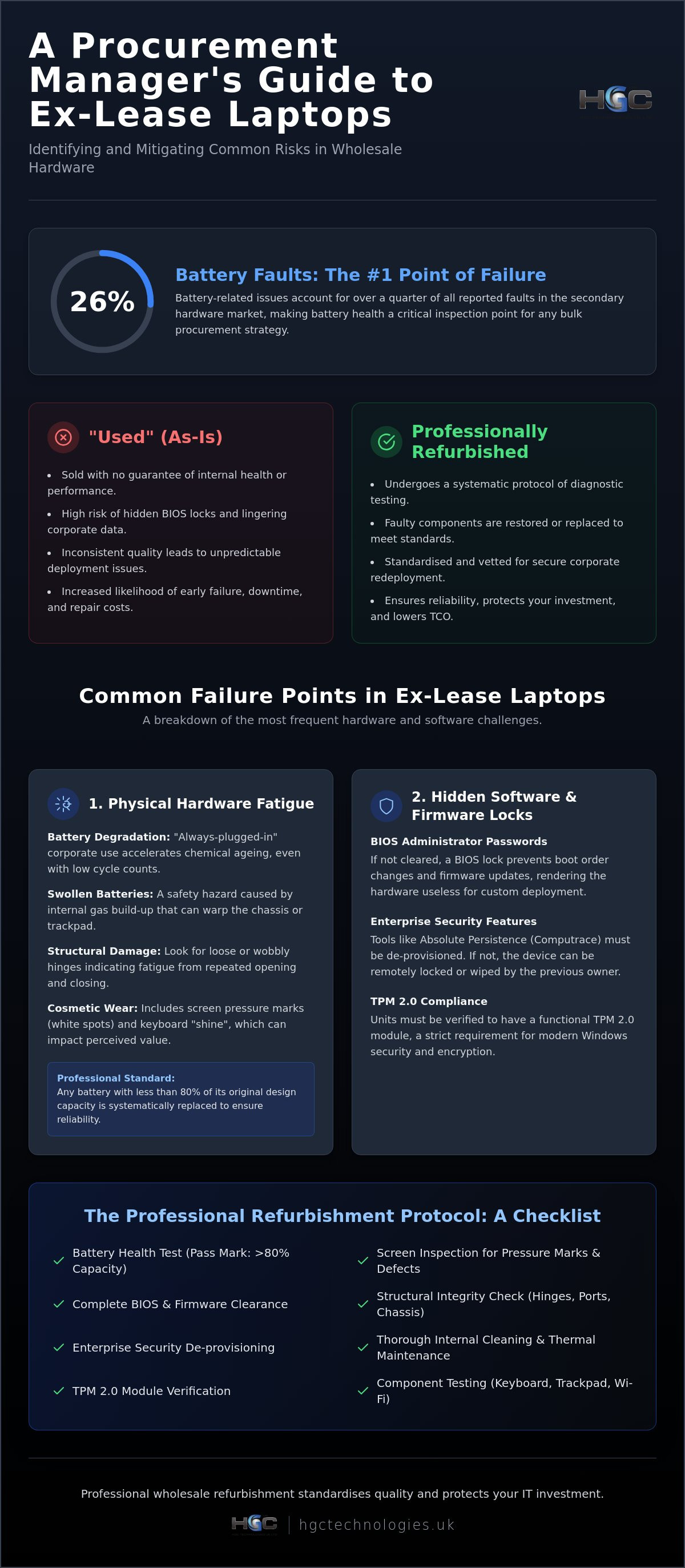
Did you know that battery-related faults account for 26% of all reported laptop issues, making them the single most frequent point of failure in the secondary hardware market? When you are procuring technology for a growing workforce, the prospect of encountering common problems with ex-lease laptops like hidden BIOS locks or inconsistent battery health can feel like a significant strategic gamble. You expect your investment to yield reliable, enterprise-grade Dell or HP machines, not a fleet of units that require immediate troubleshooting or costly repairs.
We understand that procurement managers need more than just a low price; they require certainty and high standards. This 2026 guide will show you how to identify, mitigate, and resolve the most frequent issues found in wholesale batches to ensure your IT infrastructure remains resilient. We will provide a professional framework for evaluating ex-lease stock, explain the rigorous refurbishment process for Lenovo and other tier-one brands, and give you the tools to source high-quality hardware that aligns with your long-term business goals.
Key Takeaways
- Identify how three-year corporate usage cycles impact the long-term reliability of premium enterprise hardware from Dell, HP, and Lenovo.
- Uncover common problems with ex-lease laptops, including hidden BIOS locks and enterprise security features that can obstruct seamless deployment.
- Master the nuances of UK refurbishment grades to ensure your procurement strategy delivers consistent quality and protects your business margins.
- Establish a robust inspection and sample-testing protocol to validate the integrity of bulk technology shipments before they reach your end-users.
- Learn why professional wholesale refurbishment provides a strategic advantage by standardising quality and performance across high-volume orders.
Understanding Common Hardware Failures in Ex-Lease Laptops
Ex-lease laptops represent a strategic opportunity for businesses to secure premium hardware at a fraction of the cost of new units. These machines are typically high-end Dell, HP, or Lenovo models returned after fixed three-year corporate contracts. Because they were originally built for the enterprise, they possess a build quality that far exceeds consumer-grade alternatives. However, corporate usage patterns create specific hardware "fatigue" that differs from domestic wear and tear. Identifying common problems with ex-lease laptops is essential for protecting your long-term IT investment ROI.
There is a fundamental distinction between "used" and "professionally refurbished" hardware in a wholesale context. A used laptop is often sold "as-is" with no guarantee of internal health or data security. Professional refurbishment involves a systematic protocol of diagnostic testing and component restoration. Understanding Refurbishment grades and quality standards ensures that you are not simply buying second-hand stock; you are investing in assets that have been vetted for corporate redeployment.
Battery Degradation and Lifecycle Limits
Corporate users often leave their laptops docked and plugged in for the duration of their working day. This "always-plugged-in" behaviour keeps lithium-ion cells at a constant high state of charge and temperature, which can accelerate chemical degradation even if the cycle count remains low. You may encounter units that appear pristine but struggle to hold a charge for more than an hour. A more serious issue is "swollen battery" syndrome. This occurs when internal gases build up, causing the battery to expand and potentially warp the chassis or trackpad. Reliable refurbishment partners typically enforce an 80% health threshold, replacing any cells that fall below this standard to ensure field reliability.
Cosmetic Wear vs. Structural Damage
Distinguishing between superficial blemishes and structural failures is a vital skill for procurement officers. Keyboard "shine," where the keys become smooth and reflective from finger oils, is a purely cosmetic issue that does not affect the mechanical switch. Conversely, loose or wobbly hinges are a sign of structural fatigue, often found in laptops that have been frequently opened and closed during travel. Screen pressure marks are another frequent find. These small, bright white spots appear when the lid is compressed against the keyboard whilst in a laptop bag. Although they do not hinder functionality, they can impact the resale value and the perceived quality of the hardware amongst your staff.
Technical and Software Challenges in Pre-Owned Corporate Fleets
While physical inspections are vital, the technical hurdles within corporate fleets are often invisible until deployment begins. These common problems with ex-lease laptops frequently stem from the very security measures designed to protect original corporate data. In a 2026 cybersecurity environment, firmware integrity isn't just a preference; it's a prerequisite for any secure IT infrastructure. Failing to account for these "hidden" roadblocks can lead to significant delays and increased labour costs during the provisioning phase.
Enterprise-grade security features, whilst beneficial for the original user, can become severe deployment roadblocks for new owners. A machine that looks pristine on the outside might be digitally "handcuffed" on the inside. Ensuring that your vendor has a deep understanding of these technical nuances is the only way to maintain a high-velocity rollout. Partnering with a specialist who prioritises firmware clearance ensures your bulk laptop procurement remains efficient and risk-free.
BIOS Locks and Firmware Security Risks
The most significant roadblock for any reseller or IT manager is the BIOS administrator password. If a unit is BIOS-locked, you cannot change boot orders, disable legacy features, or update critical firmware, rendering the hardware virtually useless for custom deployment. Equally critical is the de-provisioning of Absolute Persistence, formerly known as Computrace. If a unit remains linked to a previous tenant's security console, it may be remotely locked or wiped without warning, even months after purchase. In 2026, you must also verify that all units meet strict TPM 2.0 requirements to maintain compatibility with modern Windows security standards and encryption protocols.
Thermal Performance and Internal Maintenance
Internal dust accumulation is the silent killer of enterprise hardware. Over a three-year corporate lease, cooling fins inevitably become clogged, and factory-applied thermal paste dries out. This leads to aggressive thermal throttling, where the CPU intentionally slows down to prevent overheating. This doesn't just frustrate the end-user with sluggish performance; it significantly reduces the long-term longevity of the silicon. Listen for a grinding or high-pitched whine from the chassis, as this typically indicates fan bearing wear. Professional internal cleaning and the application of fresh thermal compound are non-negotiable steps that distinguish industrial-scale refurbishment from simple second-hand sales.
Deciphering Refurbishment Grades and Quality Standards
Navigate the UK refurbishment market with caution, as the absence of a legally mandated universal grading standard creates a landscape of ambiguity for IT procurement officers. Whilst consumer-facing platforms might use "Grade A" as a marketing buzzword, professional wholesalers treat it as a technical specification. This lack of standardisation means that a batch labelled as premium by one vendor might only meet the "Grade B" criteria of another. For IT resellers and corporate buyers, this discrepancy is more than just a naming issue; it directly impacts profit margins and deployment timelines. If you receive a shipment that doesn't align with your expectations, the additional labour required to sort and re-grade the units quickly erodes your return on investment.
One of the most common problems with ex-lease laptops is the discrepancy between aesthetic appearance and functional health. A professional grade should always be a composite of both. A unit from a reputable wholesaler undergoes rigorous multi-point functional testing, ensuring that every internal component from the Wi-Fi card to the cooling system operates at peak efficiency. This differs sharply from private eBay sellers who often base their grading solely on a quick visual inspection of the lid and screen. In a wholesale environment, "Grade A" represents a commitment to both physical excellence and operational reliability.
The Difference Between Grade A and Grade B Batches
Grade A batches are the gold standard for client-facing roles and executive use. These units show minimal cosmetic imperfections, possess full structural integrity, and maintain high battery health. In contrast, Grade B units feature noticeable scuffs, minor scratches, or slight keyboard wear. These imperfections don't hinder performance but offer significant cost savings. Grade B stock is an ideal solution for internal back-office functions, educational environments, or any scenario where functional reliability takes precedence over a "like-new" appearance.
Screen Defects: Dead Pixels and Pressure Marks
Screen quality is often the primary factor that determines the final grade of a wholesale laptop. Professional refurbishers often refer to the ISO 9241-307 standard to define acceptable levels of dead or stuck pixels. Beyond pixels, you must look for "white spots" or pressure marks. These are caused by poor storage or heavy stacking during the lease return process, where the keyboard is pressed into the LCD panel. Whilst they are only visible on light backgrounds, they are a hallmark of lower-grade stock and should be factored into your evaluation of any bulk procurement order.
Mitigating Risk During Bulk Procurement: A Reseller’s Checklist
Scalable procurement demands a shift from individual inspection to systematic auditing. When managing a large-scale rollout, common problems with ex-lease laptops can easily be obscured by the sheer volume of the shipment. You must move beyond the surface-level checks suitable for a single purchase and implement a rigorous inspection protocol that treats each batch as a unified IT asset. This methodical approach ensures that your margins remain protected and your deployment schedule stays on track. A single batch of "lemons" can derail a quarterly budget if not identified at the point of delivery.
Implement a statistical sampling method to validate your order. If you are receiving hundreds of units, thoroughly testing a 10% random sample provides a reliable indicator of the entire batch's integrity. During this phase, verify component authenticity by checking that original RAM and SSDs haven't been swapped for inferior, third-party parts. Sourcing from a distributor with a transparent return policy and a robust warranty is your primary safeguard against batch-wide defects. To secure your supply chain, partner with a certified wholesale specialist that guarantees fleet consistency and provides documented testing results for every unit.
Verifying Component Longevity
Internal health is just as critical as external condition. Use SMART (Self-Monitoring, Analysis and Reporting Technology) data to audit every SSD in your sample for "Power-On Hours" and remaining write endurance. An SSD nearing its end-of-life cycle is a ticking clock for your end-users. Similarly, perform a 10-minute MemTest to stress-test RAM modules; this identifies intermittent stability issues that a standard boot-up sequence will miss. Finally, ensure all power supply units (PSUs) are original manufacturer equipment or high-quality certified replacements to prevent motherboard damage from inconsistent voltage delivery.
Ensuring OS Compatibility and Driver Support
Deployment speed relies on seamless software integration. Verify that Windows Pro digital licences are correctly embedded in the BIOS or ACPI tables to avoid activation headaches during imaging. Sourcing bulk Dell refurbished laptops often provides a strategic advantage here, as Dell’s enterprise support ecosystem offers comprehensive driver packs that simplify mass deployment. Always select models with at least 3-4 years of projected support remaining to ensure your fleet remains compatible with future security patches and OS updates.
Why Professional Wholesale Refurbishment is the Ultimate Solution
HGC Technologies UK Ltd. acts as a critical filter for IT professionals, eliminating the uncertainty inherent in bulk technology procurement. We transform raw ex-lease stock into reliable business assets by applying industrial-scale refurbishment protocols. This methodical process systematically addresses the common problems with ex-lease laptops identified throughout this guide, ensuring that every unit meets a standardised level of performance. We eliminate the ex-lease gamble. By focusing on brand-name fleets from Dell, Lenovo, and HP, we reduce the variance in hardware performance and provide a consistent platform for enterprise-wide deployment.
Sourcing from a dedicated wholesale laptop distributor UK partner provides a strategic advantage that goes beyond mere hardware supply. We offer custom configurations, including RAM and NVMe SSD upgrades, to ensure your ex-lease units meet the demanding software requirements of 2026. This tailored approach allows resellers and corporate buyers to provide high-performance solutions whilst maintaining the cost-effectiveness of refurbished hardware. Our role is to act as your knowledgeable guide, simplifying complex wholesale processes and securing your supply chain.
HGC Technologies’ Rigorous Testing Protocols
Our 25-point hardware diagnostic is the cornerstone of our quality assurance. We inspect everything from keyboard matrices and port integrity to motherboard capacitors, ensuring that "hidden" failures never reach your facility. Data security remains a paramount concern; therefore, every unit undergoes rigorous data sanitisation to HMG IS5 or NIST standards. The "HGC Guarantee" serves as the benchmark for the UK wholesale market, providing Grade A stock that delivers the reliability your infrastructure demands.
Strategic Sourcing of Corporate Models
We prioritise bulk Lenovo refurbished laptops due to their legendary durability and ease of repair, making them a favourite amongst UK resellers. To complement your hardware fleet, we also provide original smartphone supply and server solutions, allowing you to source your entire IT ecosystem from a single, authoritative partner. We are committed to helping UK businesses scale by providing consistent, problem-free inventory that supports long-term growth and environmental responsibility. Our strategic alliances ensure you have access to premium technology without the risks typically associated with the secondary market.
Building a Resilient Hardware Supply Chain for 2026
Navigating the secondary hardware market requires a shift from opportunistic buying to strategic procurement. You now understand that common problems with ex-lease laptops, such as degraded battery health and restrictive BIOS locks, are predictable patterns that can be managed through rigorous auditing. By prioritising tier-one brands like Dell, HP, and Lenovo and insisting on industrial-grade refurbishment standards, you protect your organisation from the hidden costs of deployment delays and hardware failure.
Success in 2026 depends on the strength of your supply chain and the transparency of your partners. As a specialist wholesaler, HGC Technologies UK Ltd. provides the technical expertise and testing protocols necessary to deliver high-performance fleets at scale. We act as a trusted partner for UK resellers and corporate procurement teams, offering a reliable alternative to the risks of unverified stock. Secure your high-quality refurbished fleet from HGC Technologies today and invest in hardware that supports your long-term business growth with absolute confidence.
Frequently Asked Questions
What is the most common problem with ex-lease laptops?
Battery degradation is the most frequent issue encountered in secondary hardware. According to industry data, battery-related faults account for 26% of all reported laptop problems. This is often caused by corporate usage patterns where machines remain connected to power docks for extended periods, leading to chemical wear even if the cycle count remains low.
Are ex-lease laptop batteries usually in poor condition?
Not necessarily, but they do show varied levels of wear. Whilst common problems with ex-lease laptops include reduced runtime, professional refurbishers typically test for at least 80% of the original capacity. If a battery falls below this threshold or shows signs of physical swelling, it is replaced during the industrial refurbishment process to ensure field reliability.
How can I tell if an ex-lease laptop has a BIOS lock?
You can identify a BIOS lock by attempting to enter the system setup during the initial boot sequence, usually by pressing F2, F10, or F12. If the system prompts for an administrative password before allowing access to boot priority or security settings, the unit is locked. This digital roadblock prevents resellers from re-imaging the device or updating critical firmware.
What is the difference between a used laptop and a refurbished ex-lease laptop?
A used laptop is typically sold "as-is" without professional intervention, functional testing, or certified data sanitisation. A refurbished ex-lease laptop has undergone a rigorous 25-point diagnostic, internal cleaning, and necessary component replacements. This professional restoration ensures the machine meets specific quality grades and is ready for immediate corporate redeployment.
Do ex-lease laptops come with a Windows licence?
Most enterprise-grade Dell, HP, and Lenovo models feature a digital Windows licence embedded within the BIOS or ACPI tables. This allows the hardware to activate automatically when a fresh version of Windows Pro is installed. You should always verify that the licence is for the Pro edition to ensure compatibility with modern business security standards.
Is it worth buying ex-lease laptops in bulk for a school or NGO?
Bulk procurement is highly beneficial for schools and NGOs because enterprise models offer far superior durability compared to budget consumer devices. These machines are built for intensive daily use and longevity. Sourcing in bulk allows these organisations to maintain a consistent fleet, which significantly simplifies technical support and spare parts management whilst maximising limited budgets.
How do I know if the SSD in an ex-lease laptop is about to fail?
Checking the SMART data is the most reliable method to assess the health of an SSD. This data reveals the "Power-On Hours" and the percentage of write endurance remaining on the drive. If the software identifies a high number of reallocated sectors or a low percentage of spare blocks, the drive is nearing the end of its lifecycle and requires replacement.
What should I look for in a refurbished laptop warranty?
A robust warranty should cover both parts and labour for a minimum of 90 days, though 12 months is preferred for wholesale orders. Ensure the policy clearly defines the return process for bulk shipments and covers critical components like the motherboard and LCD panel. A comprehensive warranty reflects the distributor's confidence in their internal testing and refurbishment standards.