
Calculating ROI on Refurbished Laptops: A Strategic Guide for UK IT Procurement
The most expensive decision an IT Director can make in 2026 isn't choosing the wrong software, but failing to account for the immediate value drop of a brand-new laptop the moment it's unboxed. As UK IT budgets continue to tighten under inflationary pressure, the traditional "buy new" cycle is becoming a strategic liability rather than a standard. Successfully calculating ROI on refurbished laptops requires looking beyond the initial purchase price to understand how high-spec, Grade A hardware delivers superior value over its entire lifecycle.
You likely feel the weight of balancing high-performance demands with increasingly aggressive sustainability targets and the updated WEEE compliance fees that now impact every large producer. It's a difficult tightrope to walk, especially when you're facing internal resistance from staff who equate "refurbished" with "second-rate." This guide provides the exact financial and operational framework you need to justify a shift to professional refurbished hardware. We'll break down the total cost of ownership, from reduced capital expenditure to measurable CSR gains, ensuring your next procurement strategy is backed by undeniable data.
Key Takeaways
- Master the specific mathematical formula for calculating ROI on refurbished laptops by incorporating total savings, productivity gains, and initial deployment costs.
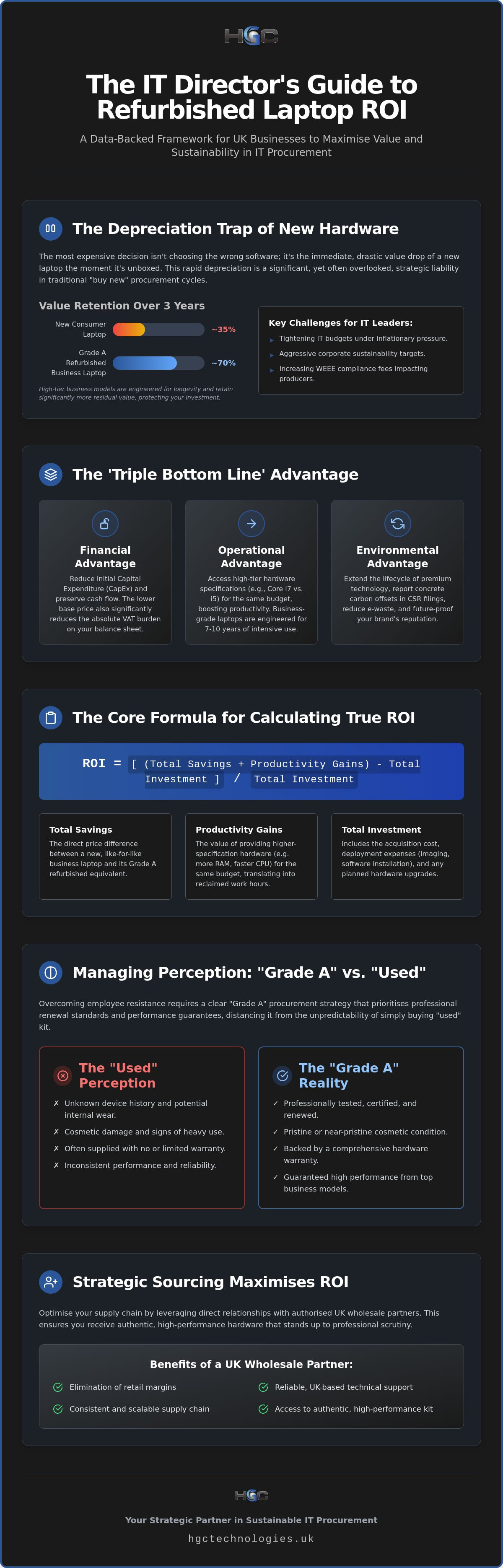
- Understand the "depreciation trap" and why high-tier business models retain significantly more residual value over a three-year cycle compared to new consumer hardware.
- Overcome employee resistance by implementing a "Grade A" procurement strategy that prioritises professional renewal standards over simply buying "used" kit.
- Optimise your supply chain by leveraging direct-to-wholesaler relationships that eliminate retail margins and provide reliable, UK-based technical support.
Understanding the ROI Framework for Refurbished IT Procurement
Strategic procurement starts with a fundamental shift in how we define value. For many organisations, Return on Investment (ROI) is viewed through the narrow lens of the initial invoice. However, calculating ROI on refurbished laptops requires a more sophisticated calculation that balances the immediate capital saving against the long-term operational efficiency of the device. True ROI isn't just the price delta between new and used; it's the measurable gain in performance per pound spent over the asset's functional life.
Business-grade laptops from manufacturers like Dell, HP, and Lenovo are engineered for 7 to 10 years of intensive use. When these units are professionally refurbished to Grade A standards, they often outperform brand-new consumer-grade alternatives in both durability and processing stability. This creates a "Triple Bottom Line" for IT leaders. You gain a financial advantage through reduced acquisition costs, an operational advantage through high-tier hardware specifications, and an environmental advantage by extending the lifecycle of premium technology.
CapEx vs. OpEx: The Financial Shift
Procuring bulk refurbished laptops allows UK businesses to preserve vital cash flow for other strategic investments. By reducing the initial capital expenditure (CapEx), you lower the "break-even" point for your technology refresh cycle. In the UK, the standard 20% VAT applies to refurbished electronics, yet the lower base price significantly reduces the absolute tax burden on your balance sheet. This procurement model ensures that your hardware remains an asset rather than a rapidly depreciating liability. It's a methodical way to secure high-performance kit without the premium price tag of a "new" label.
Sustainability as a Measurable ROI Metric
Environmental responsibility is no longer a peripheral concern; it's a core component of modern procurement. Choosing sustainable IT hardware UK allows your organisation to report concrete carbon offsets in your annual CSR filings. Every refurbished laptop represents a significant reduction in e-waste and the energy-intensive manufacturing processes required for new components. As UK regulations tighten, including the 2026 WEEE compliance fee increases, the ability to demonstrate a circular economy approach provides a distinct competitive edge. You aren't just saving money; you're future-proofing your brand's reputation amongst ethically conscious clients and stakeholders.
How to Calculate ROI: A Step-by-Step Formula for UK Businesses
Moving from theoretical savings to a board-ready business case requires a precise mathematical framework. Calculating ROI on refurbished laptops isn't a matter of guesswork; it's a structured evaluation of the total lifecycle value of your hardware. By quantifying both the immediate capital reduction and the long-term performance benefits, you can present a justification that satisfies both the CFO and the technical team.
The core formula for this calculation is: ROI = [(Total Savings + Productivity Gains) - Total Investment] / Total Investment. This calculation goes beyond the purchase price. Total Investment must include the initial acquisition cost, deployment expenses such as imaging and software installation, and any necessary hardware upgrades like additional RAM or SSD capacity. Conversely, Productivity Gains represent the value of providing higher-spec hardware for the same budget. For organisations looking to maximise these figures, sourcing through an authorised UK wholesale partner ensures you receive authentic, high-performance hardware that stands up to professional scrutiny.
If your budget allows for an Intel Core i7 processor in a refurbished model whereas a new unit would only afford an i5, the resulting speed increase across a fleet of 100 employees translates into hundreds of reclaimed hours annually. These efficiency gains are a critical, yet often overlooked, component of the ROI equation.
Step 1: Establishing the Baseline (New vs. Refurbished)
The first step is a rigorous comparison of bulk Dell refurbished laptops against their brand-new equivalents. Ensure this comparison is like-for-like regarding build quality. Business-grade hardware like the Dell Latitude or Lenovo ThinkPad series offers a robust chassis and reliable internals that consumer-grade models lack. Research indicates that professionally refurbished laptops are typically 30% to 60% cheaper than new models. Identifying this immediate capital saving, which often sits between 30% and 50% for Grade A kit, provides the foundation for your financial argument.
Step 2: Factoring in Deployment and Maintenance
Successful procurement accounts for the "hidden" costs of ownership. Include the cost of imaging and software installation, which is streamlined when purchasing in bulk batches from a consistent source. Maintenance costs should be estimated based on the professional warranties provided by the refurbisher. Because business-grade machines are designed for longevity and ease of repair, they generally suffer fewer hardware failures than consumer-grade laptops. This reliability reduces the strain on your internal IT support team, further improving the operational return on your investment.
Getting Employee Buy-in: Managing the Perception of Used Laptops
One of the most significant variables in calculating ROI on refurbished laptops is the "human factor." Even the most robust financial model can be undermined if employees perceive their new equipment as a sign of aggressive budget-cutting at the expense of their professional experience. The "stigma" of receiving non-new kit is the primary objection IT procurement leads face during a hardware refresh. However, this resistance is usually rooted in a misunderstanding of what professional refurbishment actually entails. It is essential to communicate that these devices are not merely "used" items; they are units that have undergone a rigorous renewal process to meet specific industrial standards.
Transparency is your greatest tool for building trust during a hardware rollout. By explaining the professional renewal process, you shift the narrative from "second-hand" to "sustainably renewed." Employee satisfaction is ultimately linked to hardware performance and reliability rather than the "out-of-box" experience of peeling plastic off a new chassis. When a device performs flawlessly and handles intensive multitasking without lag, the initial concern regarding its age quickly evaporates.
The Power of Grade A Aesthetics
Sourcing grade A refurbished laptops wholesale is the most effective way to secure executive and client-facing buy-in. First impressions are critical. A Grade A device is cosmetically near-perfect, appearing virtually indistinguishable from a factory-new unit. When an employee receives a professionally cleaned, pristine Dell Latitude or Lenovo ThinkPad, the psychological impact is one of value and prestige. Utilising these premium brands ensures that the organisation's image remains high-calibre, whilst the internal perception remains positive and professional.
Communicating the 'Higher Spec' Advantage
Frame the procurement choice as a strategic decision to prioritise "superior performance" over a "newer box." You can demonstrate to your staff that a refurbished business-grade machine offers a better keyboard, a higher-resolution screen, and a more durable chassis than a new entry-level consumer PC. This performance-first narrative shifts the focus from the age of the asset to the quality of the tool. Additionally, aligning the hardware choice with the company's sustainability goals resonates deeply with modern employees. Highlighting the carbon offset of each device empowers staff to feel part of a wider corporate social responsibility initiative. When employees understand that their high-spec laptop is also a tangible contribution to the circular economy, the transition becomes a source of professional pride.
Total Cost of Ownership (TCO) and Depreciation Analysis
The "Depreciation Trap" remains one of the most significant obstacles to hardware ROI in the UK. When you purchase a brand-new laptop, it loses a substantial portion of its market value the moment it leaves the box. Industry data suggests that new hardware can depreciate by 20% to 30% within the first twelve months alone. By the time a three-year refresh cycle concludes, the initial capital outlay is almost entirely unrecoverable. Calculating ROI on refurbished laptops requires a clear-eyed look at this curve. Refurbished assets have already weathered the steepest part of their depreciation, meaning the delta between your purchase price and the eventual residual value is far narrower.
Operational reliability also plays a critical role in TCO. Whilst some procurement leads fear higher failure rates in refurbished kit, the opposite is often true for business-grade hardware. New laptops frequently suffer from "infant mortality" or manufacturing defects that only appear in the first few months of use. Professionally refurbished units have been stress-tested and vetted, ensuring that only stable, proven components remain in the fleet. This reliability reduces the frequency of helpdesk tickets and minimises the hidden costs of employee downtime. To ensure your hardware meets these rigorous standards, you should contact our procurement team for a bespoke TCO analysis tailored to your specific fleet requirements.
The 3-Year TCO Comparison
A rigorous three-year analysis reveals the financial superiority of the refurbished model. When you compare the cost of wholesale Lenovo refurbished laptops against their new equivalents, the total investment is significantly lower from day one. Because the entry cost is reduced, organisations can afford a shorter refresh cycle, ensuring staff always have access to modern processing power without the massive capital hits associated with new-only cycles. This approach allows you to reclaim a larger percentage of your investment when the units are eventually decommissioned or sold on.
Standardisation and Support ROI
Buying in bulk batches allows for total fleet standardisation. When every employee uses an identical model, your IT department can maintain a small inventory of identical spare parts and standardised software images. This consistency streamlines troubleshooting and makes rapid deployment a reality rather than a logistical nightmare. For specialised roles that require non-standard hardware, bespoke custom PC builds can bridge specific performance gaps whilst maintaining the same cost-effective procurement philosophy across the rest of the organisation. This methodical standardisation is a key driver of long-term operational ROI.
Strategic Sourcing: Maximising ROI with UK Wholesale Partners
The final pillar of a robust procurement strategy is the selection of the right supply partner. To truly optimise the process of calculating ROI on refurbished laptops, you must look beyond the individual unit price and evaluate the efficiency of the entire supply chain. Direct-to-wholesaler models provide the most significant financial advantage by removing the layered margins typically added by retail intermediaries. When you source hardware from a direct wholesale laptop distributor UK, you secure a more favourable entry point, which immediately improves your capital recovery projections.
Logistical speed is equally vital for operational ROI. Working with a UK-based partner ensures that deployment is not hindered by international shipping delays or complex customs procedures. Rapid deployment means your staff can begin using their high-spec hardware sooner, accelerating the time-to-value for your investment. A strategic partner acts as an extension of your IT team, providing the stock consistency and technical support necessary to maintain a high-performance fleet across multiple years.
Vetting Your Refurbishment Partner
Quality assurance is the foundation of long-term value. When vetting a bulk supplier, prioritise those who offer transparent grading systems and rigorous data sanitisation standards, such as Blancco. This ensures that every device is not only cosmetically sound but also entirely secure and compliant with UK data protection regulations. A truly strategic partner offers a unified procurement approach, providing access to original smartphone supply and server solutions alongside laptop fleets. This consolidation simplifies your vendor management and allows for more aggressive volume-based negotiations, further enhancing your total return.
Custom Solutions for Enterprise Needs
Whilst laptop fleets form the backbone of mobile workforces, specific departments often require more specialised infrastructure. Integrating enterprise server hardware UK into your procurement plan ensures that your back-end systems match the reliability of your end-user devices. For design or engineering teams, bespoke custom PC builds can provide the necessary processing power at a fraction of the cost of new workstation models. This tailored approach ensures that you aren't over-spending on entry-level users whilst still meeting the high-performance demands of technical specialists.
To finalise your high-ROI procurement plan, ensure your strategy includes:
- A like-for-like performance comparison between refurbished business-grade and new consumer models.
- A documented 3-year TCO analysis that accounts for the "Depreciation Trap."
- A clear internal communication plan to secure employee buy-in through performance data.
- A UK-based wholesale partner capable of providing Grade A stock and bespoke technical builds.
Future-Proofing Your IT Procurement Strategy
Transitioning to high-tier refurbished hardware is no longer just a cost-saving measure; it's a sophisticated method of capital preservation. By calculating ROI on refurbished laptops with a focus on long-term Total Cost of Ownership rather than just the initial invoice, you can secure premium hardware that supports both your operational goals and environmental commitments. This shift allows you to bypass the steepest part of the depreciation curve whilst providing your team with the high-performance tools they require to remain productive.
Success in this transition relies on moving past the "used" hardware stigma and embracing the proven reliability of Grade A business-grade models. Sourcing directly from a specialist UK wholesaler allows you to eliminate unnecessary retail markups and access the expert support needed to maintain a standardised, scalable fleet. This methodical approach ensures your IT budget works harder, delivering superior specifications without the premium price tag of new equipment.
Take the next step in refining your procurement model. Explore our bulk refurbished Dell, Lenovo, and HP laptops at HGC Technologies to access our direct sales model and premium Grade A stock. It's time to transform your hardware budget into a strategic asset that delivers measurable returns for years to come.
Frequently Asked Questions
How do I calculate the ROI of refurbished laptops compared to buying new?
You determine the return by measuring the total capital saved against the productivity gains of the hardware. Calculating ROI on refurbished laptops involves adding your initial purchase savings (often 30% to 60%) to the value of reclaimed employee hours provided by higher-spec components. Subtract your deployment costs and divide the result by the total investment to find your percentage return. This method ensures you account for both immediate cash flow benefits and long-term operational efficiency.
Is the lifespan of a refurbished laptop long enough to justify the investment?
Yes, because business-grade laptops from brands like Dell and Lenovo are engineered for a seven to ten-year functional life. A Grade A refurbished unit typically enters the market after only three years of use, leaving significant high-performance headroom. These machines often outlast brand-new consumer-grade alternatives because they utilise superior chassis materials and more robust internal cooling systems, making the investment highly justifiable for corporate environments.
How can I get employees to accept refurbished laptops instead of new ones?
Focus on a "performance-first" narrative that emphasises the superior specifications of the hardware. Explain that a refurbished business-grade machine offers a better keyboard, screen, and processing speed than a new entry-level PC. When staff receive a Grade A device that looks pristine and handles intensive multitasking without lag, the "newness" factor becomes irrelevant. Aligning the choice with your company's sustainability targets also helps turn procurement into a shared environmental win.
What are the hidden costs of buying refurbished laptops in bulk?
The primary "hidden" costs involve standardised imaging and the 2026 WEEE compliance fees. Whilst the hardware price is lower, you must still budget for software licensing and the logistical time required for fleet deployment. Additionally, larger retailers and producers now face updated environment agency charges for electronic waste recycling. Factoring these regulatory costs into your initial budget prevents surprises and ensures your financial model remains accurate throughout the hardware lifecycle.
Do refurbished laptops come with a warranty that protects my ROI?
Professional refurbishment partners provide comprehensive warranties that function similarly to new-product guarantees. These warranties typically cover hardware failures for twelve months, protecting your return on investment by eliminating unexpected repair costs. Sourcing from a reputable UK wholesaler ensures that you have a direct point of contact for support. This level of protection is vital for maintaining fleet uptime and ensuring that your capital savings aren't eroded by maintenance issues.
What is the difference between Grade A and Grade B refurbished laptops for business ROI?
Grade A units are cosmetically near-perfect and are ideal for client-facing roles or securing employee buy-in. Grade B units may show minor signs of wear, such as light scratches, but offer a deeper discount that can further improve your ROI. For back-office staff or server-room applications where aesthetics are secondary to performance, Grade B hardware provides a lower entry point and a faster "break-even" period on your investment.
How does depreciation affect the return on investment for IT hardware?
New laptops suffer from a "depreciation trap," losing up to 30% of their value in the first year alone. Refurbished hardware has already moved past this steep initial decline, meaning it retains a higher percentage of its purchase price over your ownership period. When it's time to refresh your fleet again, the residual value of a refurbished business-grade machine is often comparable to a new one, resulting in a much lower total cost of ownership.
Can refurbished laptops meet the security standards required by UK enterprises?
Refurbished business laptops are fully compatible with modern enterprise security protocols, including TPM 2.0 for Windows 11 compliance. Professional refurbishers use industrial-grade data sanitisation software like Blancco to ensure every drive is wiped to government standards before a clean OS is installed. This process ensures that your hardware is as secure as a factory-new unit, allowing you to meet strict UK data protection requirements whilst still calculating ROI on refurbished laptops that favours your budget.